
Incident Management
Rapid, expert-led response to contain, resolve and learn from cyber security incidents.
Talk to the response teamCyber Security Assurance
Practical cyber security assurance for organisations that need to understand their exposure, test their defences and respond decisively when incidents occur. Siker combines incident response, penetration testing, OSINT and phishing exercises with clear reporting that turns technical findings into action.
Defence and forensics practice
Investigators and responders, not report writers.
Assurance
Use these services to validate controls, improve response readiness and give leadership a defensible view of current cyber risk across people, processes and technology.
Rapid, expert-led response to contain, resolve and learn from cyber security incidents.
Talk to the response teamExpert-led, real-world attack simulations to uncover vulnerabilities before attackers do.
Talk to the response teamTurn publicly available information into actionable intelligence on your organisation's real-world exposure.
Talk to the response teamRealistic, controlled phishing simulations to build a resilient, security-aware workforce.
Talk to the response teamDefinition
Two halves of the same discipline: reducing the chance and impact of compromise, and establishing the truth when one occurs.
Defensive security is the day-to-day work of visibility and control: knowing what you run, collecting the right telemetry, writing detections that match real adversary behaviour, and rehearsing the decisions you will have to make under pressure.
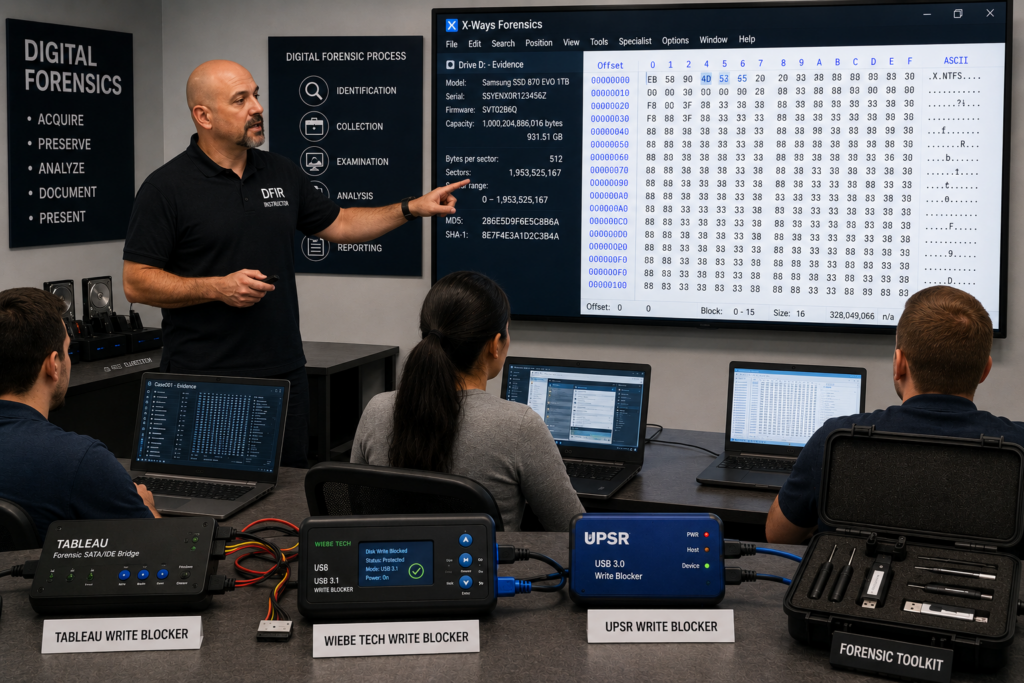
Digital forensics begins where prevention ends. It is the structured acquisition and analysis of evidence - disk, memory, mobile, cloud and network - to reconstruct what happened, in what order, and with what impact, without altering the material you rely on.
Together they close the loop. A well-run investigation tells you which control failed, and that answer becomes the next detection, the next segmentation change and the next piece of training for the team.
Our Capability
Delivered by practitioners with law-enforcement, CNI and enterprise response experience.
Detection engineering, log strategy and use-case development so alerts map to real adversary behaviour rather than vendor defaults - across enterprise, cloud and industrial networks.
Hypothesis-led hunts using host and network telemetry to find the activity that automated tooling missed, with findings fed back into your detection stack.
Containment, eradication and recovery support, with playbooks written for your environment and constraints - including safety-critical and production systems.
Forensically sound acquisition and analysis of Windows, Linux, cloud and mobile evidence, documented to a standard that stands up to scrutiny.
Court-ready reporting, statements and expert testimony from investigators with law-enforcement and criminal-justice experience.
Instructor-led forensics and defensive security courses through the Siker Academy, so your analysts can run the process themselves next time.
Approach
A simple cycle, run properly. Most organisations we meet are strong in one phase and thin in the other three.
Phase 1
Readiness assessment, logging and evidence-retention review, response plan and playbook development, tabletop exercising with the people who will actually be called.
Phase 2
Tuned detection content, triage workflow and escalation criteria so an alert becomes a decision quickly instead of sitting in a queue.
Phase 3
Structured investigation and containment with clear communication lines for executives, regulators, insurers and legal counsel.
Phase 4
Root-cause analysis, forensic timeline, lessons-learned workshop and a prioritised hardening plan that closes the path the attacker used.
Next step
Whether you are building detection from scratch or dealing with something live, tell us what you are seeing and we will tell you what we would do first.
Questions
Digital forensics is the disciplined recovery, preservation and analysis of digital evidence so that findings are accurate, repeatable and defensible. It covers acquisition of disks, memory, mobile devices, cloud services and network artefacts, timeline reconstruction, and reporting to a standard suitable for disciplinary, civil or criminal proceedings.
Cyber defence is continuous - monitoring, detection, hunting and hardening to prevent and limit compromise. Forensics is investigative and largely retrospective: establishing what happened, when, how and by whom, to an evidential standard. The two work best together, because good defensive telemetry is what makes a later investigation possible.
Yes. We can assist with triage, evidence preservation, containment advice and investigation, and work alongside your internal teams, insurers and legal advisers. Contact us with an outline of what you are seeing and what systems are affected.
Yes. Investigations touching control systems require different handling: acquisition must not disturb the process, safety systems are off limits for active tooling, and evidence often lives in engineering workstations, historians and jump hosts rather than in an EDR console.
Our forensics work follows recognised good practice for continuity and integrity of evidence, and our investigators have prepared reports and given testimony in criminal and civil proceedings.
Our Cyber Security and Forensics curriculum runs from foundation through to practitioner level, covering investigation methodology, tooling and defensive operations, and can be delivered in-house or as public courses.